Showing posts with label Japan. Show all posts

Tuesday, June 11, 2013

[Lyrics] - Shikao Suga - Aitai


Due to another video being taken down, here is  Shikao Suga latest single: Aitai. 
I tried to adapt the lyrics to the song this time while incorporating the theme of the song as much as I could.

Aitai adaptation

I really hate
Making me hold hands on a date
Funny thing is that I hate letting go
I’m a pain to be with, trust me, I know

Drives me mad
The only thing I hate more than the old
Is sitting here and watching my nails grow
Someone like me –
Can never ever be loved

But you
You’re my one in a million
The only one that has been
Able to put a kiss on my heart

But you
If you ever left me
I hope that my whole heart
Would freeze and turn as cold as ice

Hate kisses
I hate that moment when we touch
Hate thinkin’ of our privates and such
The blood and stuff is way too much
Just like me
I hate spider when they are still
But even noisy ones aren’t a thrill
Someone tell me –
Why is the world so cruel?

But you
You’re my one in a million
The only one that has been
Able to make me feel this way

But you
I only want you to know
About my pain
And all about my sadness

Only you
You’re my one in a million
The only one that has been
Able to put a kiss on my heart

But you
If you ever left me
I hope that my whole heart
Would freeze and turn as cold as ice

Aitai literal

I hate holding hands
But I hate letting go even more
I think it’s a pain too
Drives me mad
I hate the smell of grown ups
I even hate when my nails get long
Someone like me doesn’t have the qualifications to fall in love

Aitai
There’s no one else but you
No one else has be able to kiss my heart
Aitai
If you ever left me
I hope my heart becomes cold and freezes

I hate kissing, I hate the moment I’m touched
I hate my own genitals even more
Feels like blood would get on you
I hate spider, they are quiet like me
But don’t like noisy insects either
Hey, someone tell me why the world is so cruel

Aitai
There’s no one else but you
No one else has drown in these feelings
Aitai
I only want you to know
About my sadness and the same pain
Aitai
If you ever left me
I hope my heart becomes cold and freezes

大キライ 手を握られたりするのキライ
放っておかれるのもキライ
めんどくさいって 自分でも思う
狂うくらい 大人の臭いとかキライ
爪がのびてくのもキライ
こんなわたし 恋愛の資格もない
アイタイ
あなた以外 誰一人
心に直接 キスできた人なんていない
アイタイ
あなたがもし 去っていく日は
心ごと全部 冷たく凍結してほしいの
kiss
キライ 体触れる瞬間キライ
自分の性器 すごくキライ
あなたに血が付きそうで
自分みたい じっとしてる蜘蛛 大キライ
うるさい虫も好きじゃない
ねえ 世界って どうしてこう残酷なの?
アイタイ
あなた以外 誰一人
こんな気持ちに 溺れたことなんてない
アイタイ
だから この悲しみと
同じ痛みを あなただけ知ってほしいの
アイタイ
あなた以外 誰一人
心に直接 キスできた人なんていない
アイタイ
あなたがもし 去っていく日は
心ごと直接 冷たく凍結して欲しいの

Monday, April 1, 2013

What is a P?

Besides a miserable pile bad samples?

Lately, the tag has been often added, or even self added to end of user names. Since I am a bit involved in the world of VOCALOID, I thought I would look into exactly what a "P," or producer is considered in Japan. Yes, I realize I am rather late to the party, but better late than never, right?

Wednesday, December 26, 2012

Japanese Middle Schools - The School Year

Japanese Middle, or Junior High Schools, have a number of interesting differences. I'll start from the minor items and work up to the more interesting things in different articles.

First off, the school day. There are usually six periods in a day. The classes and the order of classes are different everyday. For example, first period could be math on Monday, and then science on Tuesday. The subjects include: Math, Science, Social Studies, Japanese, English, Physical Education, Technical Education, Art, Music, Ethics and Home Economics. The standard subjects such as math and science are usually everyday. The other classes are rotated in and out, or are once a week. First period starts at 8:40AM at my school. The kids have to be seated for "homeroom" by 8:15AM. Unless you live the mountains or the middle of nowhere, there are no buses. They have to either walk or bike to school. Each period is 50 minutes and after classes are finished, club activities start almost right away.

There are all kinds of clubs for the students to join. To name a few: Basketball, baseball, volleyball, tennis, soccer, brass band, and art club. Since the time that the sun sets in Japan changes drastically from summer to winter, the times for clubs change as well. In the summer, it's usually from 4PM to 6:40PM. In the fall, it's from 4PM to 5:15PM. In the dead of winter, clubs are only until 4:15PM because it's pitch black by 5PM. This is a safety measure since most of the students do club activities, and most have to walk or bike home.

Lunch time. Lunch is after 4th period everyday. The students eat in their own classrooms in most schools. The meal is usually cooked up in a lunch center somewhere in the city, then delivered to the schools. The students get their lunches from where the lunch was dropped off, take it to their classrooms, then serve it to each of the students. Only after each student has been served can they start eating. After they've finished, they take it all the trays and dishes to where they got it from, so it can be delivered back to the lunch center for cleaning.

Next, cleaning time. After 6th period (or after lunch in some schools), the students clean the school. Each class is broken into groups, and each group has an assigned area to clean. One group could be the classroom, another the hallway or the bathroom. Most schools only have the standard weapons for the war against dirt: dust cloths, brooms, sponges and etc. There is almost always no running hot water in the schools, so using dust cloths to clean the floor in winter can be... not-so-fun.

Breaks are also different. Winter break starts before Christmas and ends "some time" after New Years. This year the break started from 21st of December, and school starts January 7th. Here, the school year starts after spring break, in April. Spring break starts from the third week in March, to the second week of April. Those breaks are relatively long, but their summer break is quite short. It starts from the third week of July until September. As a matter of fact, they still come to school after summer break starts in Elementary schools. They get weekends off, but since most of the students have clubs, they usually come back on Saturday and some Sundays for practice or tournaments. In middle school, they have club activities throughout all of their breaks.

That's most of what I can say about the most basic things for now. Next time, I'll talk a bit about the role of teachers in schools. If you have any questions, please ask!

Tuesday, November 13, 2012

-Bōnenkai-

-忘年会-
Literally, "forget the year meeting." 

Anyone who has the pleasure of socializing in Japan has probably noticed profound effects of alcohol on the average Japanese person. The red face, reduced space-bubble, increased boisterousness and "need to touch things." It's great really because it opens up people that are otherwise quiet and normally harder to talk to.

Japanese people, especially teachers, work extremely hard and need a chance to unwind every once in a while. One particular chance is called a Bōnenkai. It is a socializing event at the end of year, and is to forget the troubles of the past 365 days; there's no better method than the consumption of a lot of alcohol. 

I had the pleasure of attending one of these last year and it was quite the experience. 

These kinds of events are usually split into parts: the official meeting and the after party(ies). The first part is usually a standard, formal party. The one that I attended was at a fancy Japanese restaurant. After the opening ceremony, people usually walk around with adult beverages and fill each others glasses up. At these kinds of events it's a pretty big faux pas to fill your own drink. You either have to wait until someone comes around to you, or fill someone else's glass, then have him fill yours (no homo). However since these are often a race to see who can get the most wasted first, you won't be waiting long. 

There are often various games to go along with the festivities. Ranging from Bingo and how many 4 stroke kanji can you write, to rock paper scissors tournaments and guess which of these hands belongs to the opposite gender.

After closing the main event, many hold an after party. Now no longer under an official setting, the juice is let loose and all hell breaks out. The particular after party I went to was held at a karaoke establishment.

The most memorable part of the night was with a gentleman that was really getting into it. I had not talked to him much before but I could tell that he was having a pretty good time. I could tell because most Japanese adults (unlike my students) are usually not as straight forward with analyzing the tactile quality of my hair. However he was having no problems that night. 

Karaoke places usually have accessories and garments that you may equip to increase(?) your singing stats. The closest available one was the Cat Paw. According to him, the appropriate way to using such an item is to hold your hand out like a stop sign, bend your fingers at approximately 45 degrees, and then say "nyaa" at no more than 55 decibels. The dynamics of this art are harder than one may estimate. He was very strict but I eventually gained his approval. 

After being forced gently encouraged to sing Baby by Justin Bieber by the other participants, I wondered as to where my Cat Paw master had gone. He shortly appeared in an AKB48 outfit and proceeded to entertain me with a lap dance during my performance. He, equipped with the miniskirt and Cat Paw™, could not be more than 2mm away from me for the rest of the night. 

The after party ended a couple more songs... and drinks. 
If you ever have chance to go to a Bōnenkai, I have several tips:

1. Do not pound drinks: Your (apparently) bottomless drinking hole will only encourage others to test your might.
2. Eat before going: There will be food... You will not get to eat it.
3. Take A LOT of money: You might run your wallet up around 10,000 to 15,000 yen.
4. Take this as a chance to really talk and socialize with your co-workers. There are few other chances to get them to loosen up.

Another faux pas is mentioning any potentially damaging event that occurred during drinking in public. Ever.

Monday, July 2, 2012

Applying for an ALT Position

I work for Interac (also known Selti or Maxceed), as an Alternate Language Teacher. I've been getting a lot of questions about how I got this job lately, so I'll try to give some information for people who want to get into this line of work. I will be speaking from my experience from applying to Interac.

Requirements:
The only thing that you absolutely need is a college bachelor's degree. So, before you apply you should either have graduated and have your degree, or be graduating soon. Note that you need to be able to prove this with the actual degree or a scan/picture of it. Before I got the job with Interac, I applied for Amity. I didn't get the job seemingly because at the time I had an outstanding debt with my college and they couldn't check for my graduation status. The interview went well, but I was not hired since I could not show my diploma; even though I had graduated.

So being able to show that you have graduated (or will soon) is the first hurdle. I believe you will finally need to prove it after the interview.


Application:
I applied on-line through Interac's website. Much like any other on-line application, they will ask for some personal information. Items such as your full name, age, date of birth, current address and a picture. You will also be asked to give information such previous job experience and education. They will ask if you have any certificates such as TEFL. You don't need to have it to be hired (I don't have it), but I'm sure it helps. The application also has a field for the other languages that you know. They will also ask when you would like to take vacations. I'm not entirely sure why they ask this as the only time you'll really be able to travel is during the summer and winter. So I would put in dates between July-August or the end of December. Another item is where you would like to be placed if hired. You can put what you like here, but you are almost guaranteed to not get it in your first year. Don't worry and shoot for what you like. Two short essays are also part of the application process. Basically, they want you describe what kind of experiences you are looking forward to in Japan, your work ethic and experiences with children.

There is also a place to upload your resume. I would recommend telling them as much as you can about yourself here, especially in the essays. Show all of your work experience and that your are interest in working in Japan. The also want letters of recommendation so ask your professors and people from your previous jobs if you can.

Phone Screening:
Should your application go well. You will be asked to talk with one of their representatives. They will ask what the best day for you is and set a time. The times are usually in MST so be careful. During the phone call they will ask pretty much what you expect. "Have you ever been to Japan? Have you ever worked with children? What kind of person are you? Do you like long walks on the beach?" They basically ask the things that they didn't get to in the on-line application.

Speaking of the on-line application, there are two things that they want right about now. A TB test and a criminal background. Even if you are positive that you don't have TB (which nobody would -ever- have now) or that you have never killed anyone (...), you must send these in.

I personally think that the phone call is the first part of their personality screening. Sound bright, positive and show that you know the difference between liking kids and being able to work with kids.

Interview and Demo Lesson:
If everything has been good so far, they will send you an email and have you decide when and where you want to take your interview. Luckily for Interac, they have plenty of sites for interviews. So you shouldn't have to travel very far to get to one. There were approximately 20 people that took the same interview with me. The first thing they will do is explain a bit more about the company. How the company started, what it does, how you will work and some of the expectations of you should you be hired. After that, they want each of you to present a demo lesson in front of the other interviewees and a video camera. The whole demo should be under approximately 5 minutes long. They have a number of on-line sources that explain and show you want they want, but its basically four things.

1. Self introduction
Your name, age and a quick word. About 30 seconds to a minute long. The also want you to say something in Japanese. Even if it's as simple as "Yoroshiku Onegaishimasu."

2. Reading
They want you to read a prompt in a clear voice, at a smooth pace. About 30 seconds to a minute long.

3. Sample Warm-up
A quick warm-up lesson about simple topics such as numbers, colors and vocabulary. A clear presentation of simple English in any way you like to a phantom class. Songs and chants are the most common. About 2 minutes long, give or take

4. Sample Lesson
Showing that you can set up a lesson with a couple of phantom students. Setting up the lesson, explaining the activity and encouraging your illusionary students. This is also about 2 to 3 minutes long.

You don't have to be super amazing or have a ton of experience, but show that you are willing to give it your best and that you have prepared. They want these to be clear cut and around 5 minutes long, so it would be wise to bust out the candle and mirror and practice... even just a little bit. The rest of the interviewees will not say a word, so you'll have to pretend there is a child there for the last two items.

After all of the lessons, you take a personality sorter and quick English test. The English test is just to check that you are not a brick, to be honest. I'm pretty sure I bombed it.... But try your best at it. It has things like, "Is this spelled correctly? Is this sentence correct? How does a GPS triangulate your location?"

Last, you will have a one on one with your interviewer. He will ask questions much like the ones during the phone screening. He will ask more personal questions as well, such as "What does your family think?"or, "Where do you see your self in two years?" At this time, they will also ask you job related questions such as, "What do you do if a child is being troublesome?" and "How many schools do you think would be too much for you?" The interviewer will also ask if you have any questions for him or her and that will be about it.

Look sharp and prepare. There are many people that don't prepare for interviews... That's fine but do look into the demo lessons. I believe it will help your chances immensely.

Hired?:
A couple of weeks afterwards, they will send an email bearing good or bad news to you. This whole process takes about 4-6 months, depending on when your applied. Since the times that you start the job are either in March or August, it would be wise to start in February or October.

I hope this helps anyone trying to apply to a company such as Interac or Similar companies. If you have any questions, please don't hesitate to ask.

Friday, June 1, 2012

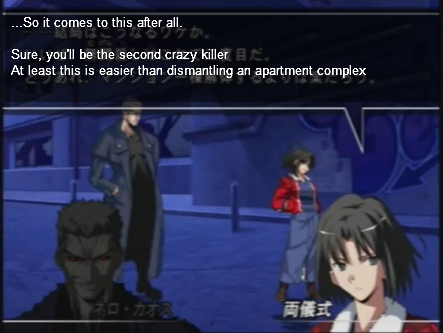
Projects: Melty Blood

I started doing some of the character stories mostly due to wanting know what was going on myself. I would definitely say that I was not as experienced with translating or even Japanese at the time. It took a significant amount of time and guidance do these at first, but I was satisfied with the results. After translating them, I posted a recording from the PS2 version of Melty Blood and used annotations. As I got better at it, I was able to use more complex software for the subtitles, and it became less time consuming to simply translate the Japanese. I could focus more on the individuality of the characters.

Characters are hard to translate. You cannot just translate what is being said, you have to "translate the character."  You need a good idea of "who this person is" when you translate dialog. Dialog is not static. We all have individuality and experiences that change who we are. This of course influences how we talk in general and even how we talk to certain people. There are over 30 individual characters in Melty Blood, and most of them vary in how they talk and act when alone and with others. What is harder is translating characters that are well known in their respective communities. Melty Blood is based on a fairly popular visual novel, Tsukihime. I need to make sure that I also match the character's manner of dialog to the vision of what people already have and expect of them.

Calm down Matt
What I needed to keep in mind for most of these is, "how do people see this character already?" I can't have an established smooth talking, fancy characters talking like B-Boy from 5th street. It throws the reader off. Admittedly, this mistake is in a lot of my earlier work.

KnK reference to Sōren
On the subject of fancy, many character have highly embellished abstract speech models. I'll talk more about translating "complex/fantastic" works later, but the writers for Melty Blood, Type-Moon, often fall into this category. Japanese is a wonderful language for expressing feelings and imagery... and like a 2 frame mashable jab, they abuse the hell out it, for lack of better words. This poses a problem... how do I express these abstract visions in English? Thanks to this I feel I have a fair amount of experience with the kind of classic dialog found this type of media.

As for research, I needed to brush up on characters that I was not familiar with. I needed a good idea of their personality. I have a good idea about most characters, but I did need to have a look at some. For example, I needed to take a look at Kara no Kyōkai in order to understand some the references and Ryougi herself.

I think that these all went pretty well for the most part. I still cringe at some of my older work but I find them passable for the most part. I will definitely keep the personality and speaking habits of each character in mind should I do another one in the future. 

It's been a while since I've done a Melty Blood character story, but it's definitely on the list of things I would like to get to. My ultimate goal is a localized version, or at least fan translated version of MBAACC. We will see what happens from here though.


Sunday, March 25, 2012

Secret Art of the Kancho

I'm sure you've heard all about the kancho. Adolescents and occasionally adults running rampant and putting the fingers into places they don't belong... of course unless you're into that kind of thing. I'm often asked, "Howwwwwww did this even start!?" "Whennnnnnnn did it become acceptable to stick fingers in peoples butts!?" Part of being a translator is reflecting the culture of the target language. I hope to inform you on it a little more with this article.

What is "kancho?"

My highly reliable sources (wikipedia) describe it as a prank found in eastern countries. The word comes from the Japanese word 浣腸 [kancho] (lit: enema). It it the act of clasping your hands together and extending your index fingers, then promptly thrusting them into the anus of an unsuspecting victim. A prank similar goosing or wedgie. Supposedly, you're to yell "KANCHO" as you commit this act, but to my experience it's a silent offense for the most part. Since this kind of thing is extremely uncommon back home, people that come from western counties to work with Japanese children, only to have a small finger stuffed... somewhere, are understandably confused or even offended in some (often repeated) cases.

Origin

The kancho probably came from something called the 三年殺し [san nen goroshi] (lit: three year killer). Some say the meaning is that this super secret move will kill the opponent in three years, or the pain inflicted by said move will last for three years. Similar to the kancho, you use your extend fingers, but you also use your middle fingers as well. Instead of focusing on the anus, the point of the move is to strike the perineum (the area between your stuff and your anus), temporarily incapacitating your opponent. You're probably wondering why I am talking about this move like it's some kind of technique in some perverted martial art. This is because it is actually a move, but in a legitimate style of karate.

Its foundation is in a style called  Shourinji Kenpo. It's a Japanese art that is composed of techniques borrowed from Shaolin Kung Fu; they say that it is written in the documents concerning techniques of this style. Masutatsu Oyama, considered a martial arts god by many Japanese people, is the founder of a modern art called Kyokushinkai. This martial art composed of many styles that Oyama learned while becoming stronger and forming is own style of karate. It's said that while documenting the techniques of Kyokushinkai, he mistakenly wrote it in from Shourinji Kenpo.

Hilarious, right? A "secret move" like this in the style considered, "the first and most influential style of full contact karate."

From there, the san nen goroshi would make appearances in manga and anime. A big one was a comedy manga called トイレット博士 [toiretto hakase] (lit: Toilet Professor/Dr. Toilet/ Toilet PhD). Due to its influence, it would become the "kancho"that we all know and love today.

Today

So today, it's basically a harmless prank that kids do to each other when young. Mostly boys but you see girls do it too. It's not like you do it to everyone. It's mostly within circle of friends and a way to show affection... though immature, affection. You wouldn't stick your finger in the rectum of someone you didn't like, right? Of course it's not all fun a games. There are yearly reports of fingers being broken, or tail bones being hurt due to excess force. Some kids even get E.coli from... yeah. Since even adults may commit this act at times, there have been battery and or bodily harm cases against individuals that have attempted this against others.

What do you think?

When I was in middle school, there was a juvenile prank called "open ____." Where you would slap a defenseless part an unsuspecting victim. So of course there were things like open chest... or open nuts... Coming to Japan, I was prepared for anything due to our proud public education system in America.

Well there is information for you. Based in fact? It's hard to tell, but it seems to be how this happened. Now what do you think?

Sunday, February 19, 2012

Never Can Say Goodbye

As it is coming down to the end of this school year, the question that I get the most from my students now is, "So what are you going to do next year?" Why do they want to know? If they are first or second year students, then they want to learn with me again the following year. If they are third year students, many have a younger sibling that are coming in and would like to hear about me from them. What I can't tell them though is, "no, I will not be here next year."

Originally, I had planned to stay another year in my area. Over the past year, I was able to make a lot of good friends. The kids are well behaved (for the most part) and the teachers were looking forward to working with me next year. Unfortunately, the Board of Education here has different plans. For the following school year, they intend to use a different company. I wouldn't really have anything to say about that if it wasn't for the probable reason of money. In Yamaguchi, they try to have ALTs in as many schools as possible. However, in recent years, they have be trying to cut back on the money that they spend, going with cheaper and cheaper companies.

This has me thinking about the actual usefulness of ALTs, in relation to how they are changed so frequently. As you may have heard before, Japan is a nation of shy people. It takes a while to get accustomed to new people and create bonds. The first couple of months were a bit rough. I was breaking into this kind of work and the kids and teachers were breaking into me. In a society that takes a long time to get used to unfamiliar people, how can an ALT be effective if they are constantly being shuffled in and out?

Dispatch companies are almost like vending machines for foreigners. If the current one wants to leave, get a new one. If you want to save money, get a new dispatch company. "Why would you use the 120yen machine when there is a 100yen machine around the block?" Assuming that all ALTs do the same work it makes little difference who you get. "It doesn't matter if we use a cheaper company." I don't mean to elevate myself but I do a lot. Staying for club activities on a daily basis, volunteering to help in unscheduled classes, going to events and being able to communicate in Japanese. Not only is there no guarantee that the new teacher will do these things, but they will have to get used to yet another ALT. The kids are used to changing ALTs more than anything from all this.

I would like to see dispatch companies search for prospect teachers that are willing to stay in one place for more than a year. People that are willing to take the time to truly bond with their schools and communities. If the true aim of ALTs is to bring foreign culture to Japan, then you need someone that can stay to truly permeate the community that they are living in, that's the Japanese way after all. It takes time. That way, perhaps things like being "underbid" by other companies wouldn't happen. That kind of thing doesn't help anyone. What do you guys think?

Maybe I'm just mad. Well, the next guy gets paid less than me... so he can hold that.

Tuesday, January 10, 2012

Japan to Increase Foreign Employment

There was an interesting article in the Mainichi Newspaper (Jan. 4th) that caught my eye. The newspaper sent a survey to 122 major companies in Japan. Around 23% of the responses said that they want to increase foreign employees by spring of next year. 50.8% of all responses show plans to increase foreigners in the work place in ten years. Though a reason for many people coming to Japan would be to take advantage of the strong yen, there is a strong movement to employ individuals from advancing nations and incorporate their practices.

I spoke with a teacher about what this means for students in Japan. To make a long conversation short, there needs to be a revision on how English is taught to students. In a work place that is bound to have more workers for Asia, English is likely to be come a more common tool for the work place. However, kids that come out of school (and took English even a little seriously) in Japan have what you could call a "firm base in reading and writing English." This of course doesn't mean that they can speak and communicate said target language. There are students that do their best and learn the language as a language rather than a subject, but as a whole there is something lacking.

As an ALT, it is my job to help improve this reality... but it doesn't seem to be enough. I wonder what can be done more to give students more practice and confidence in English?