Tuesday, July 17, 2012

Projects: Evolution 2010 - Letter to Ecole

One of the biggest tasks I've done as a translator was to write a letter to a game company and coordinate Japanese people for an American event. 
About 2 years ago, Melty Blood (MB) would finally see the limelight. Through a series interesting events, MB became one of the major games at Evolution 2010 (EVO). EVO is -the biggest- fighting game tournament in the United States. It has been gaining more and more attention over the years and is probably the biggest stage for fighting games in the world.

In order to make sure that it would be US-MB's finest showing, I did a number of things:

1. Advertise that Melty Blood would be at EVO as a major game on multiple Japanese sites.

2. Help coordinate the people that could come. Specifically: inform them on the best time to come, help them register, tell them who they should meet to and where they would be.

3. Write a letter to the creator of the game.

Number 1 was not terribly hard. I simply posted everywhere (on Japanese BBS) about what was happening, when and where. As you can expect, many people were very interested in coming. One problem though: Japanese Melty Blood players are cheap... potentially more so than their American counterparts. So there were about 12 people that really wanted to go, but didn't have the funds to travel or wanted people to help sponsor their trip. The later was not realistic for our community, but we were fortunate that two fine gentlemen, Garu and Chelsea, could make it out.

After that, it was simply a matter of making sure they understood the details of the events (number 2). Since Paypal is not commonly used in Japan, I had someone else register them. They would then reimburse that person later. After they knew what they need, it was just a matter of them coming. After they arrived, we communicated through email to help them find the other MB players.

The last part was a more delicate than the others. I thought it would be best to involve the company that made the game, ECOLE. There are two huge problems here. Problem one: Who is Richard Meadows? Problem two: WHO THE #%!@ IS RICHARD MEADOWS?! No really, this is big. Japanese companies are super tricky. I may be the best damn translator in the world, but If they don't have someone to tell them that, no amount of work on my side will do. The best way to wedge your way in, is to know someone that knows someone (who may know someone). So I had two people help compensate for these two problems. The first person I talked to was a Japanese player that previously worked at ECOLE as a test player. He helped me talk to the company before hand and tell them that a letter was coming from my number two person, Joey Cuellar. With someone on the inside and "The granddaddy of SRK and EVO," it was a lot easier to get their attention and tell them what we wanted them to do via mail.

This kind work is different from your average translation work. Japanese can be divided into 3 parts. I will give them names to make this easier: 

Homeboy
Homeboy is the language you use with your friends and close family. Fairly loose and relaxed manner of speaking

Casual
Casual is the way you might talk to your boss or some of your co workers. Perhaps even family or neighbors that you don't talk with very often. You refrain from using certain words and you speak politely, humbling yourself at times

"Yes, Master"
This is the alien language that you don't master until you are 30. Not only do you refrain from using a lot of words that you usually use, you lower your own stature, raise who you are speaking to, and avoid even the slightest notion that you are speaking for them or putting words in their mouth. This is how you talk to the emperor.

The last one is what you use to speak to other companies in Japan, and it is extremely difficult for even Japanese people. It was necessary to write the email in this tone for this task. Here is example from the top of the letter.

Japanese:
- 突然、 このようなメールを差し上げることをお詫び申し上げます。

Translation:
- We apologize sincerely for the sudden email.

Literal:
-We humbly offer an apology for presenting a letter like this to one such as yourself so abruptly.

In the end, they only sent ten copies of the game, but it was an accomplishment for me. This is the type of work that I would like to make a living out of. Not just providing the best quality of translation, but assistance for all of the small things in the middle. 

If I was to do this again, I would like to see it all the way to the finish and interpret for the people in question... so, where is that Mad Catz deal at?

Monday, July 2, 2012

Applying for an ALT Position

I work for Interac (also known Selti or Maxceed), as an Alternate Language Teacher. I've been getting a lot of questions about how I got this job lately, so I'll try to give some information for people who want to get into this line of work. I will be speaking from my experience from applying to Interac.

Requirements:
The only thing that you absolutely need is a college bachelor's degree. So, before you apply you should either have graduated and have your degree, or be graduating soon. Note that you need to be able to prove this with the actual degree or a scan/picture of it. Before I got the job with Interac, I applied for Amity. I didn't get the job seemingly because at the time I had an outstanding debt with my college and they couldn't check for my graduation status. The interview went well, but I was not hired since I could not show my diploma; even though I had graduated.

So being able to show that you have graduated (or will soon) is the first hurdle. I believe you will finally need to prove it after the interview.


Application:
I applied on-line through Interac's website. Much like any other on-line application, they will ask for some personal information. Items such as your full name, age, date of birth, current address and a picture. You will also be asked to give information such previous job experience and education. They will ask if you have any certificates such as TEFL. You don't need to have it to be hired (I don't have it), but I'm sure it helps. The application also has a field for the other languages that you know. They will also ask when you would like to take vacations. I'm not entirely sure why they ask this as the only time you'll really be able to travel is during the summer and winter. So I would put in dates between July-August or the end of December. Another item is where you would like to be placed if hired. You can put what you like here, but you are almost guaranteed to not get it in your first year. Don't worry and shoot for what you like. Two short essays are also part of the application process. Basically, they want you describe what kind of experiences you are looking forward to in Japan, your work ethic and experiences with children.

There is also a place to upload your resume. I would recommend telling them as much as you can about yourself here, especially in the essays. Show all of your work experience and that your are interest in working in Japan. The also want letters of recommendation so ask your professors and people from your previous jobs if you can.

Phone Screening:
Should your application go well. You will be asked to talk with one of their representatives. They will ask what the best day for you is and set a time. The times are usually in MST so be careful. During the phone call they will ask pretty much what you expect. "Have you ever been to Japan? Have you ever worked with children? What kind of person are you? Do you like long walks on the beach?" They basically ask the things that they didn't get to in the on-line application.

Speaking of the on-line application, there are two things that they want right about now. A TB test and a criminal background. Even if you are positive that you don't have TB (which nobody would -ever- have now) or that you have never killed anyone (...), you must send these in.

I personally think that the phone call is the first part of their personality screening. Sound bright, positive and show that you know the difference between liking kids and being able to work with kids.

Interview and Demo Lesson:
If everything has been good so far, they will send you an email and have you decide when and where you want to take your interview. Luckily for Interac, they have plenty of sites for interviews. So you shouldn't have to travel very far to get to one. There were approximately 20 people that took the same interview with me. The first thing they will do is explain a bit more about the company. How the company started, what it does, how you will work and some of the expectations of you should you be hired. After that, they want each of you to present a demo lesson in front of the other interviewees and a video camera. The whole demo should be under approximately 5 minutes long. They have a number of on-line sources that explain and show you want they want, but its basically four things.

1. Self introduction
Your name, age and a quick word. About 30 seconds to a minute long. The also want you to say something in Japanese. Even if it's as simple as "Yoroshiku Onegaishimasu."

2. Reading
They want you to read a prompt in a clear voice, at a smooth pace. About 30 seconds to a minute long.

3. Sample Warm-up
A quick warm-up lesson about simple topics such as numbers, colors and vocabulary. A clear presentation of simple English in any way you like to a phantom class. Songs and chants are the most common. About 2 minutes long, give or take

4. Sample Lesson
Showing that you can set up a lesson with a couple of phantom students. Setting up the lesson, explaining the activity and encouraging your illusionary students. This is also about 2 to 3 minutes long.

You don't have to be super amazing or have a ton of experience, but show that you are willing to give it your best and that you have prepared. They want these to be clear cut and around 5 minutes long, so it would be wise to bust out the candle and mirror and practice... even just a little bit. The rest of the interviewees will not say a word, so you'll have to pretend there is a child there for the last two items.

After all of the lessons, you take a personality sorter and quick English test. The English test is just to check that you are not a brick, to be honest. I'm pretty sure I bombed it.... But try your best at it. It has things like, "Is this spelled correctly? Is this sentence correct? How does a GPS triangulate your location?"

Last, you will have a one on one with your interviewer. He will ask questions much like the ones during the phone screening. He will ask more personal questions as well, such as "What does your family think?"or, "Where do you see your self in two years?" At this time, they will also ask you job related questions such as, "What do you do if a child is being troublesome?" and "How many schools do you think would be too much for you?" The interviewer will also ask if you have any questions for him or her and that will be about it.

Look sharp and prepare. There are many people that don't prepare for interviews... That's fine but do look into the demo lessons. I believe it will help your chances immensely.

Hired?:
A couple of weeks afterwards, they will send an email bearing good or bad news to you. This whole process takes about 4-6 months, depending on when your applied. Since the times that you start the job are either in March or August, it would be wise to start in February or October.

I hope this helps anyone trying to apply to a company such as Interac or Similar companies. If you have any questions, please don't hesitate to ask.

Wednesday, June 27, 2012

プロジェクト: The Girl Locked Below

大希望を持つ翻訳者のCurbehです。よろしくお願いします。

音楽大好きですけれど、意外と難しいですね、歌詞を作るのは... 

一応、音楽の歌詞を作っているから、普通の翻訳の仕事みたいにしたら...つまらない歌詞を作ってしまいます。頭の中に絵を描くのには日本語はすばらしいですが、まだまだ未熟私にはちょっと大変です。アフロを引っ張るまで考えないといけません...

Kurushiiと一緒にVOCALOIDの曲を作るの二回目でした。一回目のmasqueradeと違って、Stokholmの作詞がほぼ一日をかけてしました。

Kurushiiと曲の歌詞を作ることはちょっと変わっています。まずはKurushiiがBGMと英語版の歌詞を作詞します。英語版についているのは音節の数です。日本語に直すときにはそれに合わせないと、いい歌詞を考えても、作り直すしかありません。そこがたぶん一番難しいです。

英語版から離れてもいいですが、もともとの意味とイメージに同調することが大事です。歌詞を作るときには、やはりイメージされたキャラクターのしゃべり方、考え方、そのキャラクター自体を歌詞に映りたいですね。今回はいわゆる洗脳された抹殺ドール、と言うイメージが出てほしかったです。 可愛いけどご主人様に一歩近づいたら新しい口をあいてあげるタイプです。今は満足ですけど、もっと改良で来るところはあるはずです。

和訳した後、Kurushiiと一緒にイメージが持つかどうか確認して、発音の調整してからやっと絵を加えてアップロードします。今回の絵は友達にやってもらって、結構合うと思います。

またこんな歌をやったら、より強い言葉が使いたいですね。イメージがと浮かびやすい単語を使いこなしたいです。

Saturday, June 2, 2012

Projects: Arcana Heart 3 Information Pages

Yes. All of them.
In order to help usher a fresh anime game in with information for its would be players, I translated a fan made information page for Arcana Heart 3. This was back in 2010. I used Adobe Dreamweaver to directly edit the HTML and it was hosted on Mizuumi. The pages were made by Canon. An avid combo-video creator for games like Arcana Heart and Melty Blood.

This was not a particularly hard project at the time since I had a fair amount of experience translating fighting game material related items before. What was a challenge was the shear amount of stuff. The game has 23 characters... and the same number of Arcana with individual information of their own. I had a little bit of help, but it took a fair amount of time to finish. Canon would later update the page with links to combo-video combos, but they were left out of the translation since it wouldn't help players in the US much.

There was not too much to research in terms of the actual content. He mostly talks about how the moves work and important data surrounding them. If I did have to look up something, I'd check the Japanese wiki and BBS for supplemental information.
The bulk of my research was brought on by myself...

Fairly easy if you know FG terminology.
The game uses a lot of foreign languages for its move names. From Italian to German, Russian to Icelandic... Even some Latin is thrown in there! I took it upon myself to find translations for these moves AND keep the original language intact.

"But wait, I thought you only know Japanese and English?"

That's right. That's why it took forever to cross reverence pronunciations guides and charts or find Japanese sites with information/translations that match the corresponding katakana. From there, I could then translate it into English that reflects the original meaning.

AltusUSA did the original Arcana Heart... They did a good job but I felt that it could have reflected the original names more. The creators went through all of the trouble to use over eight different languages for their moves. I thought it would be nice to introduce them to the player. For things that would require heavier research, they used an appropriate sounding name or the Japanese for the move. There is nothing wrong with that, but its not as thorough as I would like have things.

Russian and Icelandic were the hardest
Other than that, it went pretty smoothly. The most graphical editing I would need to do was the short comic on the front page. Easy. This is the kind of work I want to take care of and incorporate in my company. If I did this again... I would definitely like to work with professionals from other languages for even better translations. I would like to reflect the original while still having it accessible. I would also like to make the page even better, better than the original.

Also, I did ask Canon if it was OK to translate the page. He was delighted to hear that people overseas were interested in Arcana Heart 3 and wanted to use his page. That kind of thing makes me the happiest.

Friday, June 1, 2012

Projects: Melty Blood

I started doing some of the character stories mostly due to wanting know what was going on myself. I would definitely say that I was not as experienced with translating or even Japanese at the time. It took a significant amount of time and guidance do these at first, but I was satisfied with the results. After translating them, I posted a recording from the PS2 version of Melty Blood and used annotations. As I got better at it, I was able to use more complex software for the subtitles, and it became less time consuming to simply translate the Japanese. I could focus more on the individuality of the characters.

Characters are hard to translate. You cannot just translate what is being said, you have to "translate the character."  You need a good idea of "who this person is" when you translate dialog. Dialog is not static. We all have individuality and experiences that change who we are. This of course influences how we talk in general and even how we talk to certain people. There are over 30 individual characters in Melty Blood, and most of them vary in how they talk and act when alone and with others. What is harder is translating characters that are well known in their respective communities. Melty Blood is based on a fairly popular visual novel, Tsukihime. I need to make sure that I also match the character's manner of dialog to the vision of what people already have and expect of them.

Calm down Matt
What I needed to keep in mind for most of these is, "how do people see this character already?" I can't have an established smooth talking, fancy characters talking like B-Boy from 5th street. It throws the reader off. Admittedly, this mistake is in a lot of my earlier work.

KnK reference to Sōren
On the subject of fancy, many character have highly embellished abstract speech models. I'll talk more about translating "complex/fantastic" works later, but the writers for Melty Blood, Type-Moon, often fall into this category. Japanese is a wonderful language for expressing feelings and imagery... and like a 2 frame mashable jab, they abuse the hell out it, for lack of better words. This poses a problem... how do I express these abstract visions in English? Thanks to this I feel I have a fair amount of experience with the kind of classic dialog found this type of media.

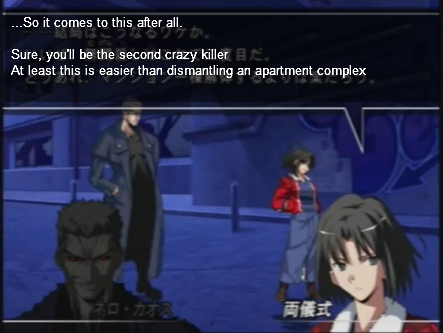
As for research, I needed to brush up on characters that I was not familiar with. I needed a good idea of their personality. I have a good idea about most characters, but I did need to have a look at some. For example, I needed to take a look at Kara no Kyōkai in order to understand some the references and Ryougi herself.

I think that these all went pretty well for the most part. I still cringe at some of my older work but I find them passable for the most part. I will definitely keep the personality and speaking habits of each character in mind should I do another one in the future. 

It's been a while since I've done a Melty Blood character story, but it's definitely on the list of things I would like to get to. My ultimate goal is a localized version, or at least fan translated version of MBAACC. We will see what happens from here though.


Projects

I have a nice PC setup now! 

To give more insight towards this "soul of a translator," I'm going to start posting about past projects and works. I'll talk about how they went, challenges, what kind of research I needed to do and my overall mindset from start to finish.

I doubt I can tell anyone "how" to translate, but I have high-standards for how translating, and a translator should be.

The ones in English will deal with Japanese to English translation. I'll also have English to Japanese translations, but the chances of those being in Japanese are higher.
I knew him well


Sunday, March 25, 2012

Secret Art of the Kancho

I'm sure you've heard all about the kancho. Adolescents and occasionally adults running rampant and putting the fingers into places they don't belong... of course unless you're into that kind of thing. I'm often asked, "Howwwwwww did this even start!?" "Whennnnnnnn did it become acceptable to stick fingers in peoples butts!?" Part of being a translator is reflecting the culture of the target language. I hope to inform you on it a little more with this article.

What is "kancho?"

My highly reliable sources (wikipedia) describe it as a prank found in eastern countries. The word comes from the Japanese word 浣腸 [kancho] (lit: enema). It it the act of clasping your hands together and extending your index fingers, then promptly thrusting them into the anus of an unsuspecting victim. A prank similar goosing or wedgie. Supposedly, you're to yell "KANCHO" as you commit this act, but to my experience it's a silent offense for the most part. Since this kind of thing is extremely uncommon back home, people that come from western counties to work with Japanese children, only to have a small finger stuffed... somewhere, are understandably confused or even offended in some (often repeated) cases.

Origin

The kancho probably came from something called the 三年殺し [san nen goroshi] (lit: three year killer). Some say the meaning is that this super secret move will kill the opponent in three years, or the pain inflicted by said move will last for three years. Similar to the kancho, you use your extend fingers, but you also use your middle fingers as well. Instead of focusing on the anus, the point of the move is to strike the perineum (the area between your stuff and your anus), temporarily incapacitating your opponent. You're probably wondering why I am talking about this move like it's some kind of technique in some perverted martial art. This is because it is actually a move, but in a legitimate style of karate.

Its foundation is in a style called  Shourinji Kenpo. It's a Japanese art that is composed of techniques borrowed from Shaolin Kung Fu; they say that it is written in the documents concerning techniques of this style. Masutatsu Oyama, considered a martial arts god by many Japanese people, is the founder of a modern art called Kyokushinkai. This martial art composed of many styles that Oyama learned while becoming stronger and forming is own style of karate. It's said that while documenting the techniques of Kyokushinkai, he mistakenly wrote it in from Shourinji Kenpo.

Hilarious, right? A "secret move" like this in the style considered, "the first and most influential style of full contact karate."

From there, the san nen goroshi would make appearances in manga and anime. A big one was a comedy manga called トイレット博士 [toiretto hakase] (lit: Toilet Professor/Dr. Toilet/ Toilet PhD). Due to its influence, it would become the "kancho"that we all know and love today.

Today

So today, it's basically a harmless prank that kids do to each other when young. Mostly boys but you see girls do it too. It's not like you do it to everyone. It's mostly within circle of friends and a way to show affection... though immature, affection. You wouldn't stick your finger in the rectum of someone you didn't like, right? Of course it's not all fun a games. There are yearly reports of fingers being broken, or tail bones being hurt due to excess force. Some kids even get E.coli from... yeah. Since even adults may commit this act at times, there have been battery and or bodily harm cases against individuals that have attempted this against others.

What do you think?

When I was in middle school, there was a juvenile prank called "open ____." Where you would slap a defenseless part an unsuspecting victim. So of course there were things like open chest... or open nuts... Coming to Japan, I was prepared for anything due to our proud public education system in America.

Well there is information for you. Based in fact? It's hard to tell, but it seems to be how this happened. Now what do you think?